
Press Release: 145+ Members of Historic Coalition that Defended the Climate Commitment Act Call on Legislature to Protect Investments and Keep Promises to Washington Voters
Contact
Kelsey Nyland, Communications Director
February 18, 2026 (Seattle, WA) – More than 145 members of the historic coalition that in 2024 defeated Initiative 2117, which sought to repeal the Climate Commitment Act (CCA), have sent a letter to Washington legislators calling on them to protect CCA investments and keep promises made to Washington voters.
From the coalition letter: “We have a responsibility to meet the moment and manage CCA revenue well. CCA funding – by design – will diminish over time as the pollution cap declines. We have this funding today, but we won’t have it tomorrow. We urge Washington leaders to use these dollars for their intended purpose: Grow our economy and create jobs, reduce climate pollution, support Tribal-led projects, and make our air healthier and safer for families across Washington.”
Read the full letter and view all signatures here.
Quotes from Coalition Members
“Climate Commitment Act investments are already delivering real benefits for Washington—strengthening wildfire resilience, reducing pollution, and supporting community‑led projects that create long‑term opportunity. These investments are especially important for overburdened communities that have long borne the costs of high pollution and are already facing climate impacts. By protecting and sustaining CCA funding, the Legislature can ensure these programs continue to expand opportunity, safeguard public health, and keep delivering on the promise voters supported. We encourage lawmakers to keep these investments moving forward for the communities that need them most,” said David Mendoza, Director of Policy & Government Relations, The Nature Conservancy in Washington.
“Climate Commitment Act investments mean real construction jobs—building clean energy projects, strengthening wildfire resilience, and modernizing our transportation systems. These are family-wage union jobs with training, safety, and benefits. Diverting these funds risks putting thousands of workers on the sidelines. We urge the Legislature to protect CCA investments and keep Washington’s construction workforce working,” said Billy Wallace, Political & Legislative Director, Washington & Northern Idaho District Council of Laborers.
“Washington state families want access to affordable, clean sources of energy to power their homes and businesses. Our limited Climate Commitment Act funding should be prioritized for increasing access to these energy sources, which offer upstream, sustainable ways to ease pressure on Washingtonians’ pocketbooks. At Puget Sound Solar, we believe climate change poses the greatest threat to our lives and livelihoods, and we urge the Legislature to use CCA funding to address this generational challenge,” said Jeremy Smithson, Founder, Puget Sound Solar.
“As a pulmonologist, I’ve seen the devastating effects unhealthy air has on Washington kids and families firsthand. Our state has always been at the leading edge of science-backed, effective climate policy. As the federal government dismantles protections for our air and water, Washington needs to double down on investing Climate Commitment Act funding in projects that clean up our air by reducing harmful pollutants like wildfire smoke and diesel exhaust,” said Dr. Vin Gupta, a pulmonary/critical care physician.
Climate Commitment Act investments catalyze benefits across the economy, environment, and the health of Washington communities.
Oversubscribed CCA Grant Programs
Several CCA grant programs that advance pollution reduction, healthy air, and affordability are oversubscribed, meaning they have received significantly more applications for funding than they have available. The Washington Electric Vehicle Charging Program Round Two (WAEVCP 2), which will award $19.4 million in CCA funds, received approximately $150 million worth of project applications. Some additional oversubscribed CCA programs include:
- Clean diesel grants for school buses
- Washington State Department of Transportation’s Zero-Emission Vehicle Infrastructure Partnerships grant
- Home Electrification and Appliance Rebates (HEAR)
- Washington low-income electric vehicle rebate
- Dairy digesters
- Tribal electric boats
Impact on Jobs & the Economy
A 2024 report found that through 2031, CCA investments could result in 45,000 new jobs across Washington with an average employee compensation 9% higher than the state median. The investments could also result in $9.1 billion in economic output. These outcomes are contingent upon CCA revenue being spent in alignment with the intent of the law: clean transportation, clean buildings, clean energy, environmental justice, climate change adaptation, and agriculture.
Impact on Wildfire Resilience
A recent report identified the significant benefits of investing in wildfire response and resilience as outlined in HB 1168. The analysis finds that fully funding HB 1168 could, each biennium, prevent over 31,000 acres of escaped wildfire. The report also finds that for every $1 spent, $8.14 is saved in firefighting costs, property damages, and economic disruption.
Wildfire smoke is incredibly harmful for human health, and populations including children, older adults, and outdoor workers are more vulnerable to associated adverse health impacts.
Right now, wildfire resilience in Washington state faces a $60 million budget shortfall.
Impacts on Transportation Electrification
New data from the Washington State Electric Vehicle (EV) Coordinating Council shows the market share of light-duty EV title transactions fell dramatically after the sunsetting of the $7,500 federal tax credit.
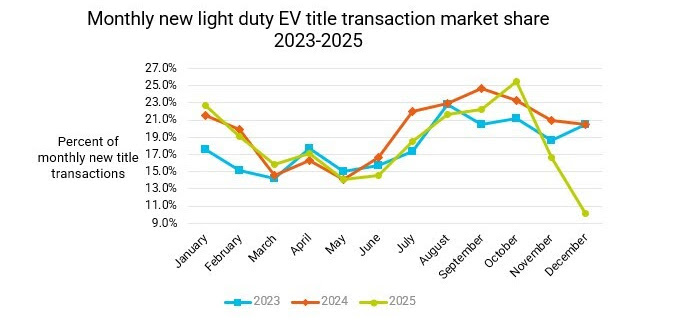
Source: WA State EV Coordinating Council
From the Council: “Used EV sales have grown consistently in the past four years, but the new EV market slowed down a bit in 2025. For the year, new title transactions (18.1%) were below 2024 levels (19.6%), but on par with 2023 (17.9%). This shift in trend showing interest for EVs continues to increase, but pricing is a growing indicator of sales success, leading to more activity in the lower-priced, used vehicle market.”
Without state-level action, Washington could stand to lose its positive trendline on EV market share growth. The State of California recently announced a $200 million EV incentive program, using cap-and-invest funding. In Washington state, the average driver of a light-duty EV can save more than $2,700 per year on fuel and maintenance, compared to drivers of gas-powered vehicles.
This comes in the context of a new study proving explicitly that increasing EV adoption lowers health-harming air pollution in communities.
Impacts on Tribal Investments
The CCA requires that at least 10% of investments support projects backed by Tribal nations. Thus far, CCA investments have gone toward projects including: A 200 megawatt solar over canal project by the Yakama Nation; supporting the Quinault Indian Nation’s efforts to relocate two main villages out of a flooding and tsunami zone; and Puyallup Tribe port electrification, including shore power and crane electrification.
A July 2025 analysis from Clean & Prosperous found that 9.5% of CCA investments support Tribal-backed projects, meaning the state has not yet met its statutory threshold.
###