How Batteries Can Supercharge the Clean Energy Transition
We are long-time battery nerds at Clean & Prosperous. For our money, batteries are the technology that can supercharge the clean energy transition today. They are affordable, safe, and can supplement existing renewable sources of power like solar, wind, and hydro.
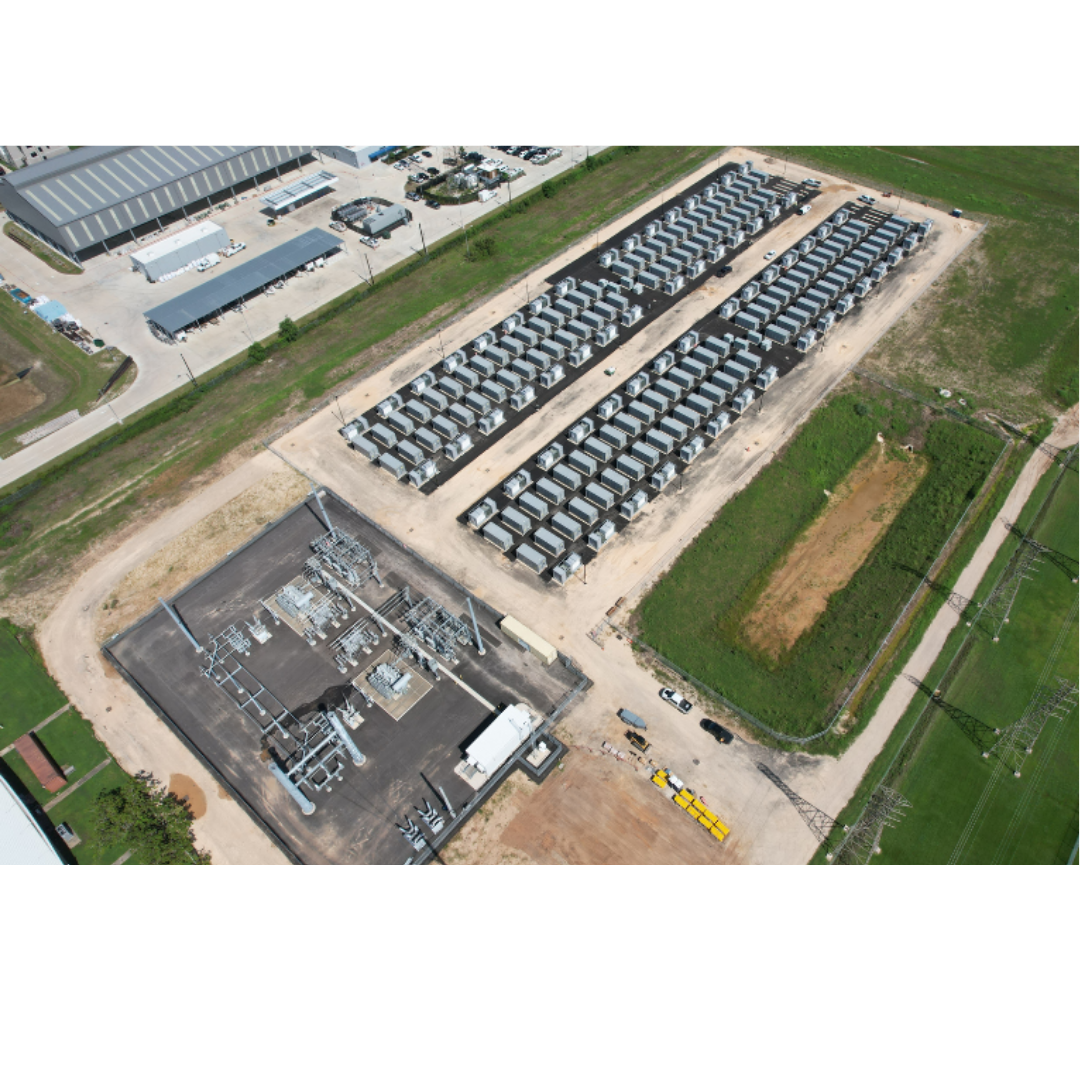
We’re going to focus on Battery Energy Storage Systems (BESS), which store power generated during times of low demand and high generation (e.g., excess solar power generated but not used on a sunny day) to be deployed for later use during times of high demand and low generation (e.g., early evening).
There are several different types of BESS:
- Short-Duration: Typically have fast response times and a duration of one-four hours. These systems are booming in California and Texas, and they’re ideal for daily peak demand “shifting” as well as contributing to grid stability during times of high demand, like heat waves or winter storms.
- Long-Duration: Typically lasts between six and 10 hours. Long-duration BESS is critical for decarbonizing our grid because of its ability to provide sustained clean power. They also have lower long-term capital costs per megawatt hour (MWh).
- Grid-Scale BESS: Typically owned by utilities or other large load customers. They provide over 100 MWh of capacity and have a very fast response time.
- Commercial/Residential BESS: Often called “behind the meter” systems, meaning they sit on the customer’s side of the electrical connection, serving the residence first and grid second. These systems increase energy affordability for individual consumers, boost individual resilience against blackouts, and are usually paired with rooftop solar systems.
Here’s how California describes the effect BESS has had on their resilience: “Battery storage, along with new clean generation resources, has strengthened the grid’s ability to meet demand during hot summer days and extreme weather. Even as California added record amounts of new clean energy and faced warmer-than-average temperatures in 2024, the grid held steady — a sign of growing reliability and resilience.”
And here is the impact BESS is having in Texas: “According to ERCOT, which manages the electric grid for most of Texas, the risk of a power demand emergency dropped from 16% last year to just 0.5% this year thanks to the enormous growth of BESS and solar energy.”
In addition to its reliability and ability to boost individual and grid resilience, battery technology is advancing incredibly quickly, which is resulting in cost reductions that are unparalleled in any other technology source.
According to Ember, in “2024 alone, average battery prices fell by 40%, hitting a record low of $165 per kilowatt hour (kWh).” In 2025, that dropped even further to $108 per kWh. This chart from Canary Media makes clear the astonishing drop in price for batteries over the last 15 years.
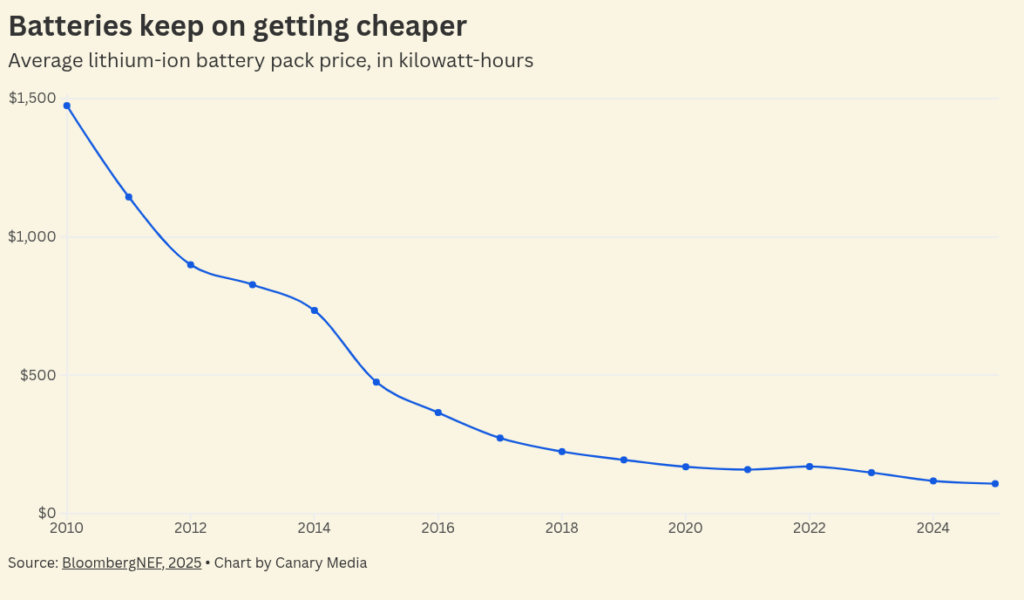
The dramatic drop in price is primarily caused by the rise of Lithium Iron Phosphate (LFP) technology, which use less critical minerals and are longer-lasting, which means they are more likely to pencil for a developer or large load customer.
Most importantly: These cost savings get passed on to ratepayers! According to the American Clean Power Association, Texas’s BESS additions have resulted in more than $750 million in electricity cost savings for consumers.
More than 13 gigawatts of new energy storage came online across the U.S. in 2025.
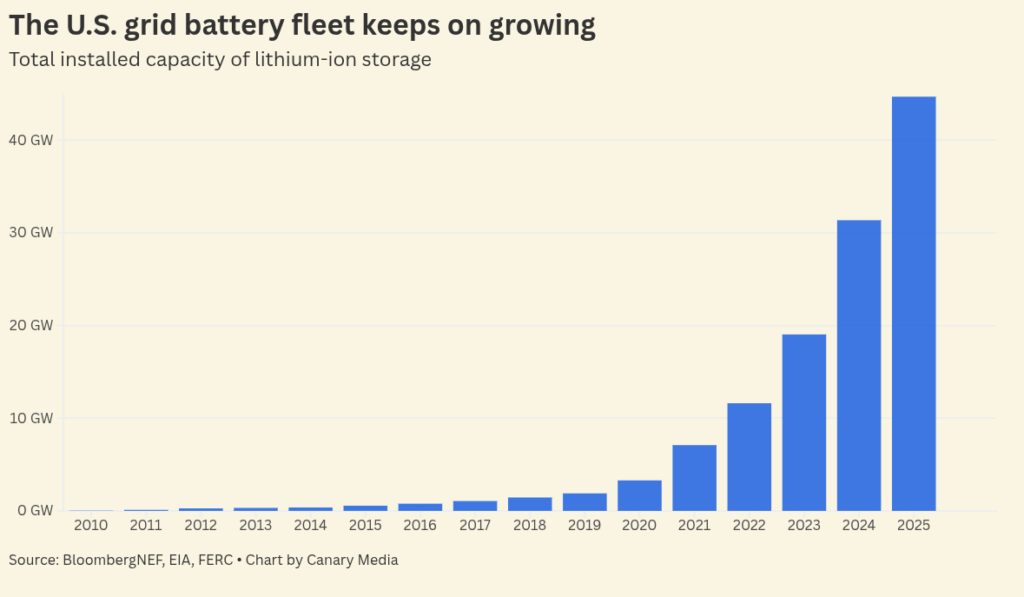
California and Texas are the two clear leaders in the growth of BESS. From Inside Climate News: “In February [2026], [Texas] passed California to become the country’s leader in battery storage capacity, with 14,984 megawatts in Texas and 14,365 megawatts in California.”
The below chart identifies the top (and middle) states for BESS – notice who doesn’t make the cut?
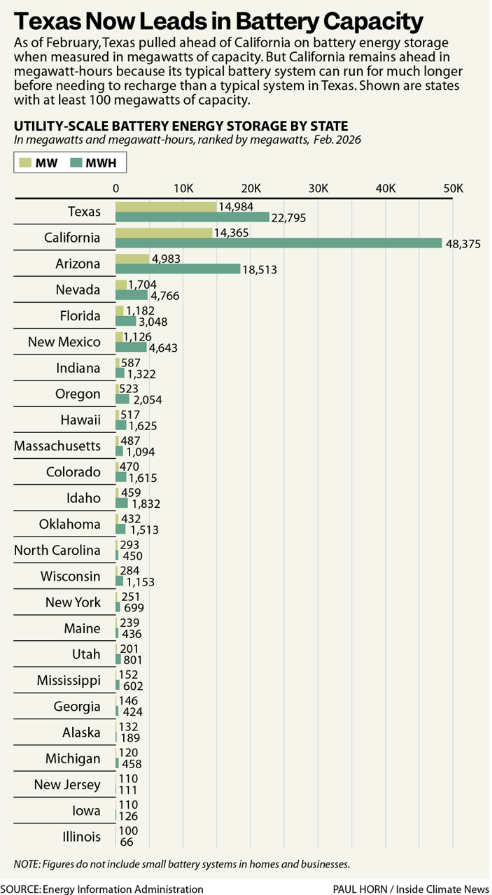
As we’ve noted, Washington state is dead last in the country in renewable growth, seeing negative three percent growth over the last 20 years. If we don’t change, Washington could lose out on 24 GW of new electricity generation, $149 billion in statewide economic activity, and $60 billion in earned labor income over the next 10 years.
In our Build Sustainable High Impact Infrastructure Together analysis, we identified 100 storage projects in Washington’s pipeline, resulting in 10.72 GW of energy capacity. Given the broader scale of our findings, these storage projects alone represent tens of billions of dollars in economic activity and thousands of jobs. These are the exact kind of facilities we want in Washington state – and we need to work across constituencies to support them.
A note about safety: Opponents of BESS projects often cite concerns related to potential fires originating from the facility. These kinds of concerns over potential fires – and the downstream effects they have on the environment – are not new and remain valid for proper planning.
However, Washington state has rigorous siting and permitting criteria for energy facilities, including battery storage. Fires at BESS facilities are rare, and fire risk is prevalent at other energy infrastructure that is already ubiquitous in our neighborhoods, including gas stations, natural gas pipelines, power lines, and even the majority of drivers in gas-powered cars with combustion engines.
Back to Texas: Here’s an extraordinary data point from the state comptroller’s office: “From September 2020 to September 2024, Texas’ total operational capacity of utility-scale batteries — large storage systems that plug directly into the grid or generation sources — increased more than 4,100 percent to 5,707 megawatts (emphasis added).” Despite that mind-boggling increase in utility-scale BESS in Texas, according to Environment America, the state “has not experienced a BESS fire despite having more than one hundred facilities.”
Battery storage projects are a crucial element of the clean energy transition. They build resiliency, make sources of clean power like solar more viable, and reduce stress on our already-strained power grid.
For anyone who made it to the end of this article: Enjoy this meme!
Registration Closing Soon for Our Study Mission 6.0: Building Bigger & Faster in Texas
From May 11-15, 2026, Clean & Prosperous will bring together policymakers, industry leaders, and clean energy advocates in Austin and Houston to explore how the nation’s clean energy growth leader is getting projects built.
We’re excited to bring together an exceptional delegation of climate, clean energy, and industry leaders, including Reps. Beth Doglio, Jake Fey, Adam Bernbaum, and Andrew Barkis, leaders from Seattle City Light and Energy Northwest, developers including BrightNight and Jupiter Power, and other key stakeholders including representatives from Amazon, the Cowlitz Indian Tribe, the Port of Seattle, and the Washington Building & Construction Trades. Spaces in the delegation are limited and filling up quickly – we encourage you to register today!
You can find the agenda here – more is still to come!
Here are the details:
- When: Monday, May 11 – Friday, May 15, 2026
- Where: Austin and Houston, Texas
- Tickets: $3,950 per ticket.
Tickets include lodging, meals, and activities in Texas. Delegation members will be responsible for their own travel into and out of Texas. You can get your tickets and find recommended flight information here.
Thank you to our sponsors for making Study Mission 6.0: Building Bigger & Faster in Texas possible!
Supporting Clean Transportation in the Surface Transportation Act Reauthorization
Last week in Everett, our Executive Director Michael Mann joined State Sen. Marko Liias, Snohomish County Councilmember Megan Dunn, Dr. Annemarie Dooley with Washington Physicians for Social Responsibility, and Dr. Janice Green with the Future of Workforce Alliance to call on Congress to protect investments in clean and electrified transportation in the upcoming Surface Transportation Act reauthorization.
Electrifying transportation isn’t just about cleaner air. It’s about lowering costs for families and businesses.
“Gas and diesel prices are incredibly volatile, and they are dependent on the global oil market. We’re seeing this play out clear as day right now, as gas and diesel prices spike astronomically due to global geopolitics. Switching to electric transportation simply makes sense…Today, driving on electricity is the equivalent of driving for less than a dollar and a quarter per gallon,” said Michael Mann, Executive Director, Clean & Prosperous.
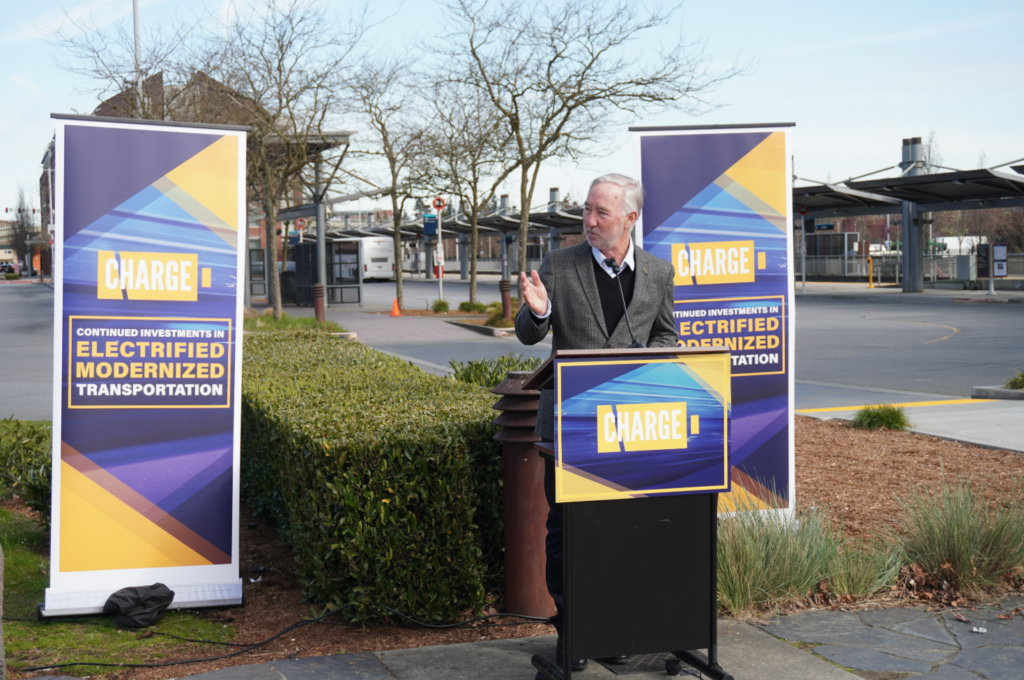
Our coalition highlighted how bipartisan investments have already delivered new American manufacturing, good-paying jobs, and lower transportation costs for families in Washington’s 2nd District, and pointed to rapidly rising energy costs as an urgent economic reason for greater investment in electrified transportation.
We’re already seeing that progress:
- Expanded EV charging networks across the I-5 corridor
- New manufacturing and workforce opportunities
- Cleaner, more reliable transportation options
As Congress works to reauthorize the Surface Transportation Act, which is set to expire this September, these investments must be protected and strengthened. Without sustained federal partnership, we risk higher costs, stalled progress, and falling behind in the global clean transportation economy.
Thank you to the C.H.A.R.G.E. Coalition for bringing us together!
Follow Clean & Prosperous
Follow Clean & Prosperous on social media to learn about our work to accelerate clean energy and power prosperity for communities across Washington. You can find us on these channels:
- LinkedIn: @clean-and-prosperous
- Instagram: @cleanandprosperous
- Bluesky: @cleanandprosperous.bsky.social