This Halloween, Visit the Spooky Clean Energy Graveyard
In January 2026, Clean & Prosperous released the Build Sustainable High Impact Infrastructure Together (Build SHIIT) map, which showcased all 258 credibly-proposed clean energy and industrial modernization projects we found in our analysis of Washington’s project pipeline.
Clean & Prosperous updated the database for the first time since January. After scouring the Bonneville Power Administration (BPA) interconnection queue, State Environmental Policy Act (SEPA) Register, Lawrence Berkeley National Lab Queued Up dataset, and media reports, we discovered a very spooky statistic.
In less than 11 months, 28 projects were withdrawn from or died in Washington’s clean energy pipeline. We created a new graveyard layer in our Build SHIIT map to memorialize these projects.
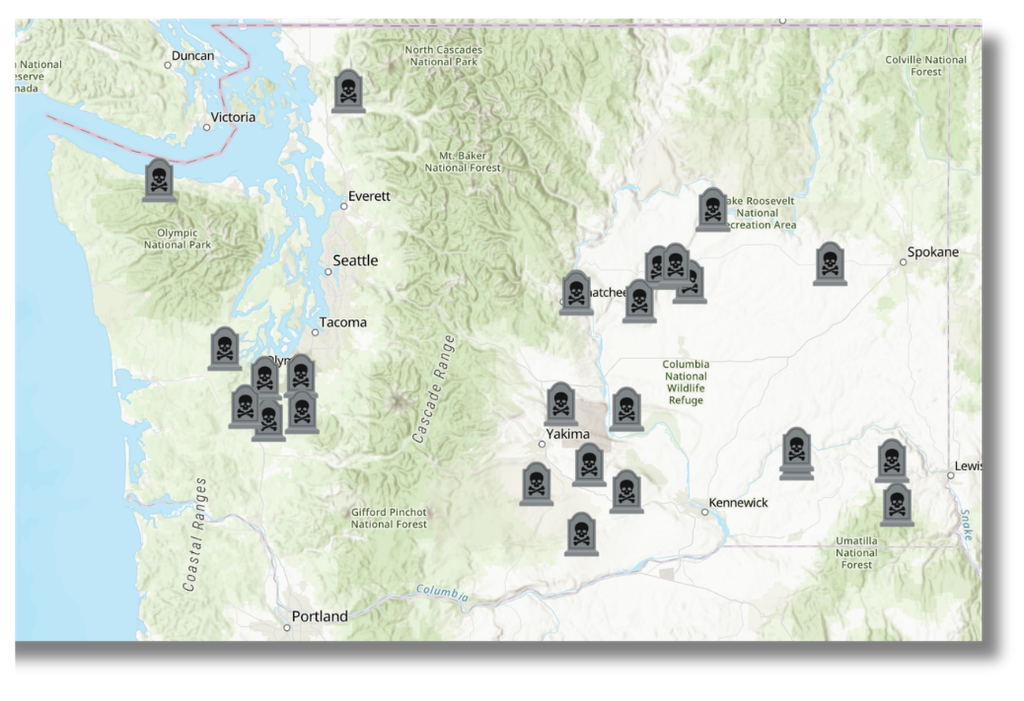
Thanks to our original Build SHIIT analysis with our friends at Greenline Insights, we are able to model the impacts of those lost projects. That’s where it gets even scarier. Taken together, they amount to:
- $11.8 billion in forgone economic activity
- 68,024 jobs (defined as job-years)
- $7 billion in earned labor income
- 4.3 gigawatts (GW) of lost electricity generation capacity
- 3.4 GW of lost energy storage capacity
That compares to four projects that were completed over the same time period, none of which were clean energy generation.
These aren’t just data points. They amount to fewer jobs for Washington workers, particularly in construction. Less economic support for small businesses surrounding project areas. Less tax revenue for local governments. And of course: A continued reliance on polluting, volatile fossil fuels, jeopardizing our goals under the Clean Energy Transformation Act (CETA) and maintaining poor air quality across Washington communities, particularly those most overburdened by climate impacts.
We cannot overstate the urgency of our shared work to build much more clean energy, much faster.
Happy Halloween!
What it Takes to Decarbonize Aviation
We recently visited the Cascadia Sustainable Aviation Accelerator (CSAA) to learn more about their work to scale sustainable aviation fuel (SAF) production and adoption across the Pacific Northwest – and globally.
CSAA works with fuel producers, airlines, investors, policymakers, and other industry partners to address the barriers to scaling SAF, from currently high production costs to infrastructure needs. Through their support for fuel research and testing, financing, infrastructure, and policy solutions, CSAA is helping make SAF production more practical and commercially viable at scale.
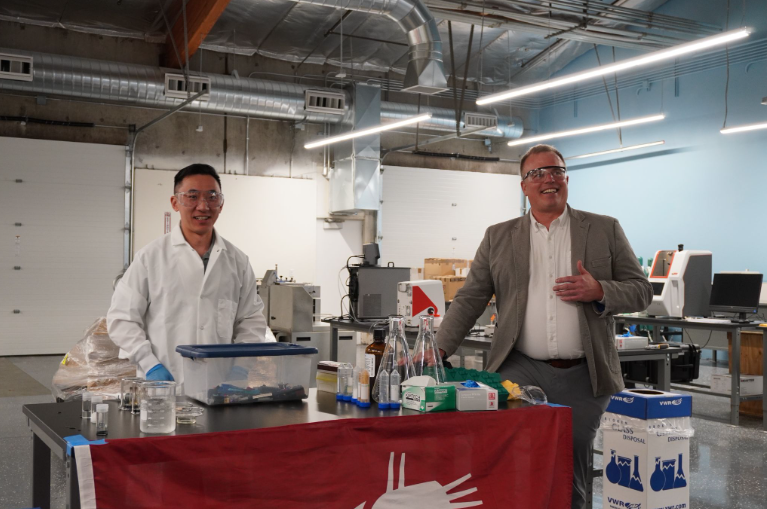
While aviation accounts for roughly two percent of global carbon emissions, that impact is expected to grow in the coming years, and SAF offers significant potential to reduce the industry’s climate impact. During our visit, we saw a demonstration that compared the pollution impacts of conventional jet fuel with jet fuel blended with SAF, offering a closer look at that potential.
CSAA aims to help grow annual SAF production in the Pacific Northwest to 1 billion gallons by 2035. With the ability to reduce lifecycle CO2 emissions by more than 80 percent, SAF could play an important role in decarbonizing aviation while supporting economic growth across the region.
Thank you to the entire CSAA team for hosting us and sharing more about your exciting work!
Follow Clean & Prosperous
Follow Clean & Prosperous on social media to learn about our work to accelerate clean energy and power prosperity for communities across Washington. You can find us on these channels:
- LinkedIn: @clean-and-prosperous
- Instagram: @cleanandprosperous
- Bluesky: @cleanandprosperous.bsky.social